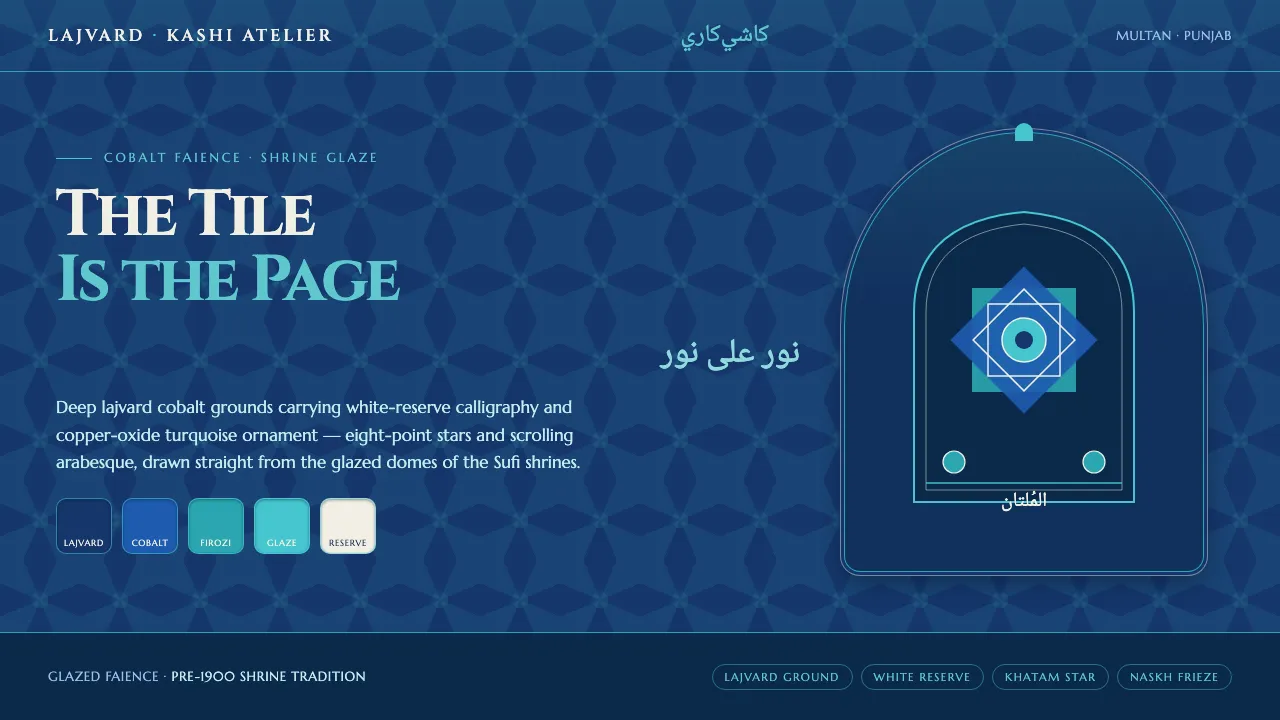
About Multani Kashi Tilework
Multani kashi-kari is the cobalt-blue glazed faience that clads the terracotta-brick domes and walls of the Shah Rukn-e-Alam tomb and the Sufi shrines of Multan. The surface reads as a deep lajvard field carrying white and turquoise floral-and-star motifs, with Quranic calligraphy reserved in white against the saturated blue glaze.
This design system distills that pre-1900 tile tradition into digital form: cobalt grounds as the dominant surface, copper-oxide turquoise accents, white-reserve highlights, and eight-point-star ornament — never the brick body beneath, always the glazed blue tile itself.
- Origin
- Multan, Punjab, Pakistan (South Asia)
- Era
- pre-1900 (mature kashi-kari tradition; Shah Rukn-e-Alam shrine, 14th c. and after)
- Key figures
- Hereditary kashigar tile-maker guilds of Multan · Shah Rukn-e-Alam shrine
- Movements
- Indo-Islamic kashi-kari · Persian-influenced glazed faience cladding · Naskh shrine calligraphy
Multani Kashi Tilework design spec
Colors
Typography
The other 11 sections — buttons, cards, spacing, motion, techniques and more — open once you unlock. Download the DESIGN.md or send it to your AI in one click. Unlock once, yours forever.
Sign up nowStyles similar to Multani Kashi Tilework
Also inspired by crafts & folk art, with a close feel.
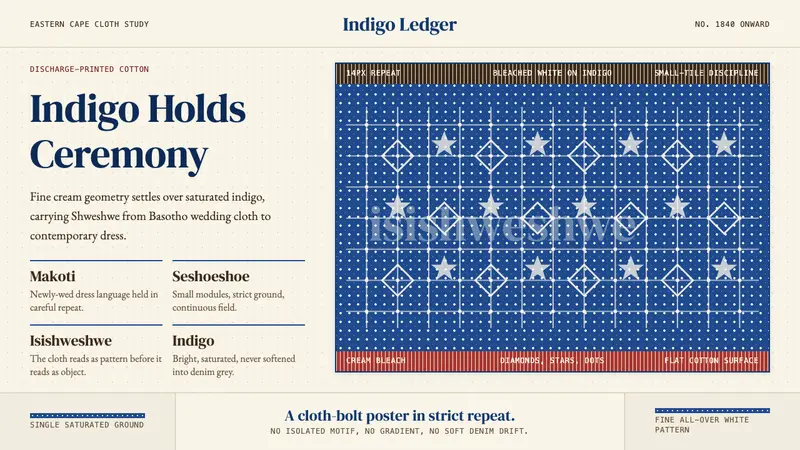 South African Shweshwe IndigoCeremony in indigo. Cream serif type and tiny bleached repeats tile a saturated cloth grid.
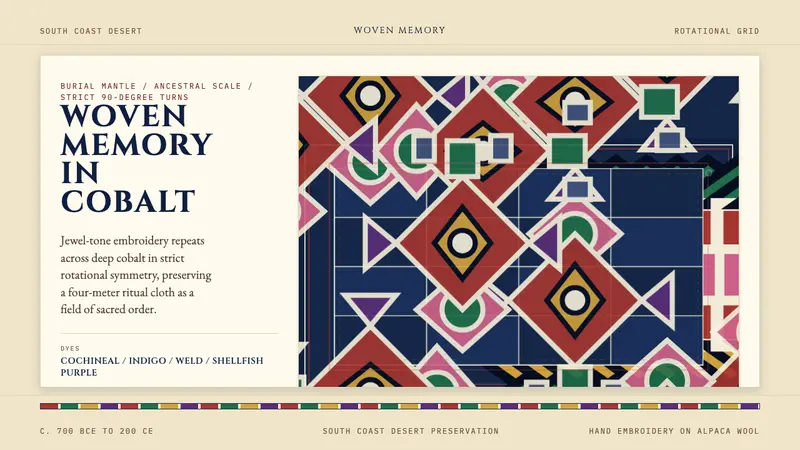 Paracas Andean TextileAncestral and exact. Jewel tones repeat on deep cobalt in strict 90° turns.
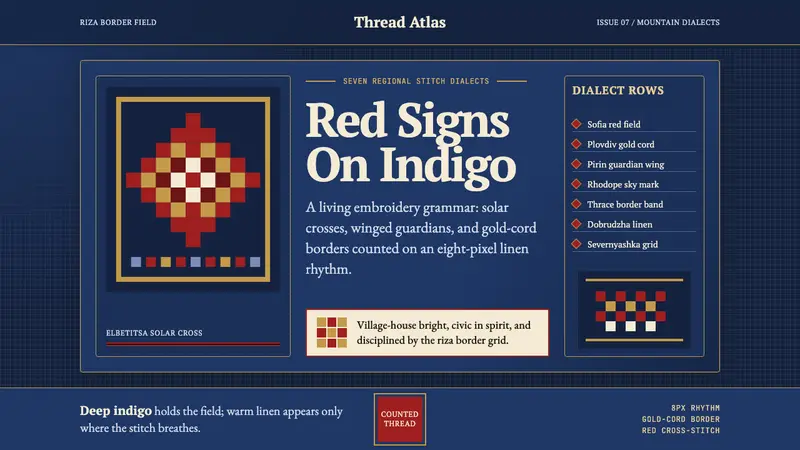 Bulgarian Shevitsa Folk EmbroideryVillage-bright code. Deep indigo carries shevitsa red crosses and gold-cord borders.
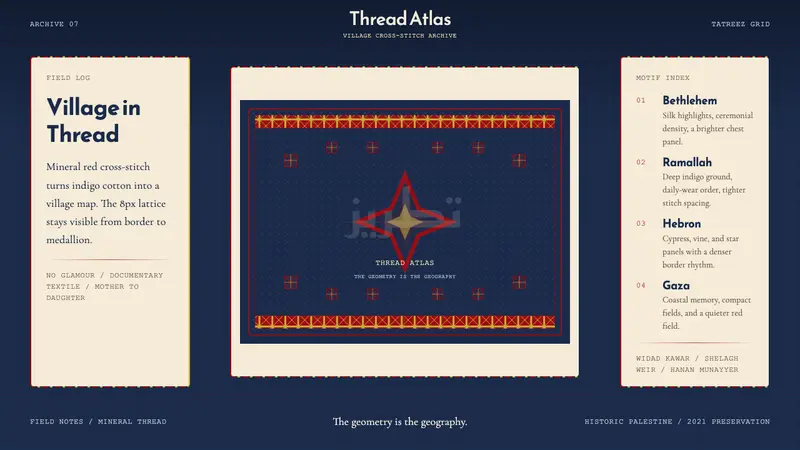 Palestinian Tatreez Cross-StitchMemory in thread. Red cross-stitch on indigo cotton, built on an 8px grid.