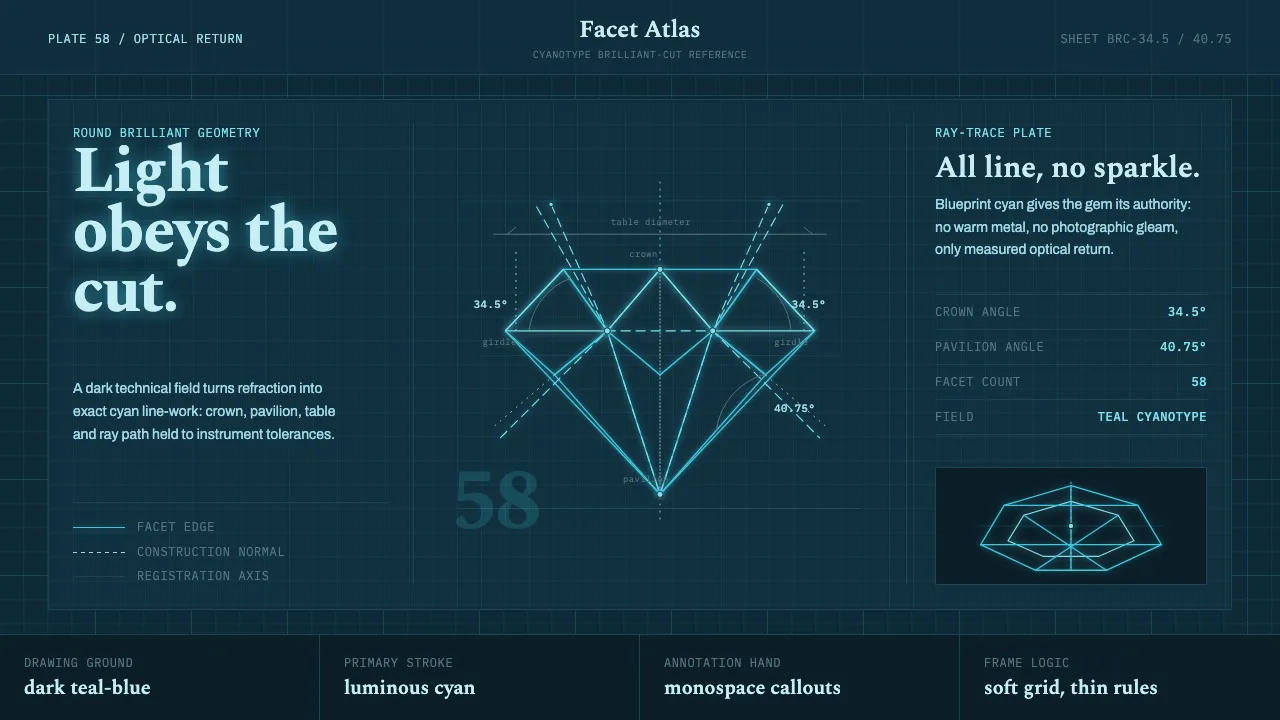
About Brilliant Cut Facet Diagram
In 1919 the engineer-gemologist Marcel Tolkowsky published *Diamond Design*, deriving the round brilliant cut from first principles of optics — crown and pavilion angles tuned to trap and return light. His plates were thin black line-work on white: crown sections, pavilion sections, refraction and total-internal-reflection ray paths, dotted construction normals.
This system reissues that engineering drawing as a blueprint. The diagram inverts to luminous cyan strokes on a dark teal-blue field — all line, no fill — where 34.5° and 40.75° callouts, 58-facet geometry, and dimension figures read like a cyanotype technical print rather than a sparkling photographic render.
- Origin
- Western Europe (Antwerp / London)
- Era
- 1900–1950 (Tolkowsky, Diamond Design, 1919)
- Key figures
- Marcel Tolkowsky
- Movements
- optical ray-tracing of the round brilliant cut · technical diagram / cyanotype reproduction lineage · ideal-cut geometry
Brilliant Cut Facet Diagram design spec
Colors
Typography
The other 11 sections — buttons, cards, spacing, motion, techniques and more — open once you unlock. Download the DESIGN.md or send it to your AI in one click. Unlock once, yours forever.
Sign up nowStyles similar to Brilliant Cut Facet Diagram
Also inspired by science & nature, with a close feel.
 Pacific Kelp ForestScientific depth. Teal water, amber shafts, and vertical kelp rhythm carry the story.
 Caliper MachiningPrecision refuses drama. Steel-gray grid, mono tolerances, one bronze swarf accent.
 Mycelium NetworkUnderground intelligence glows. Amber hyphae branch over near-black soil with mono node tags.
 Glacier Arctic SurveyCold precision. Crevasse-blue panels, cyan readouts and contour grids calibrate every value.