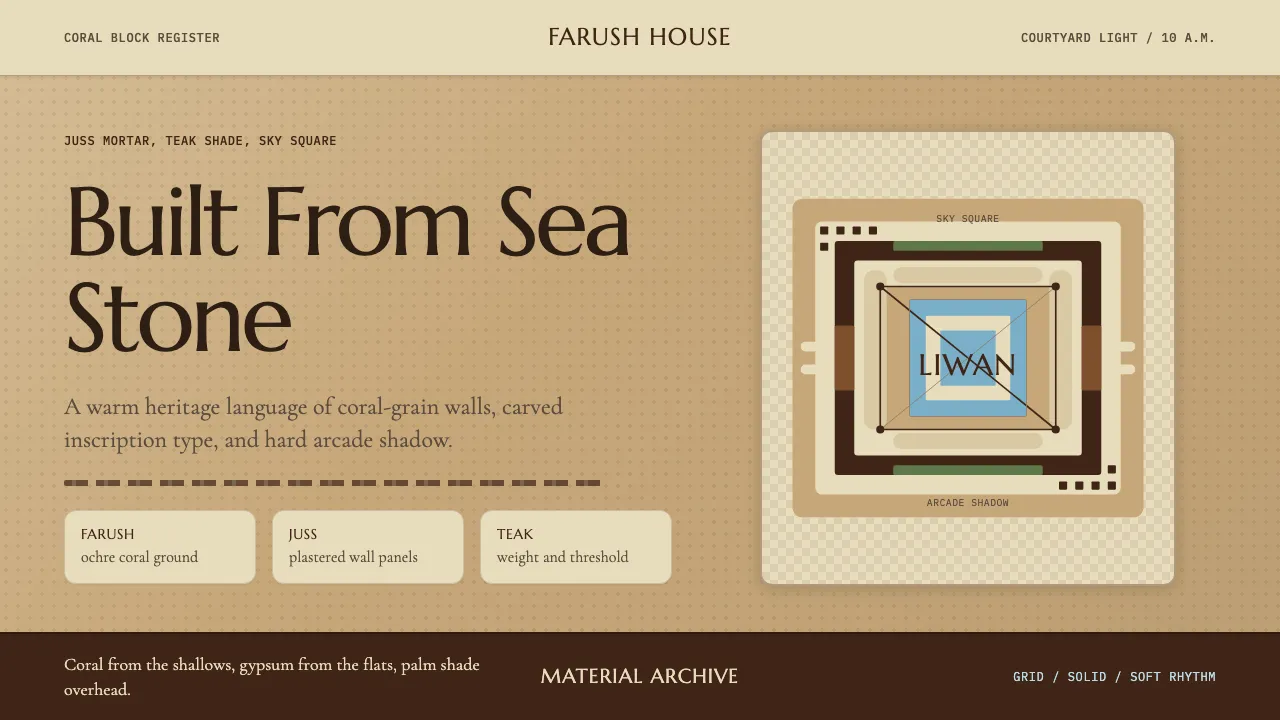
About Emirati Bait Al Naboodah Coral House
Bait Al Naboodah is the most complete surviving pre-oil Emirati urban house — an 1845 Sharjah courtyard merchant dwelling built of farush coral blocks cut from the Persian Gulf shallows, bonded with gypsum-juss mortar, shaded by danchal palm-frond ceilings, and ventilated through barjeel wind towers. The aesthetic is the courtyard at 10 a.m.: warm pale-ochre coral walls, hard arcade shadows, dark teak doors, and the sky-square above the liwan.
This design system translates those material facts — coral-stone texture, mortar smoothness, teak weight, courtyard light — into a typographic and color language that feels built rather than styled. Cards sit like juss-plastered wall panels; headings carry the wide-tracked gravity of carved-stone inscriptions; the page itself wears the warm granular color of farush limestone.
Learn more about the Emirati Bait Al Naboodah Coral House style
- Origin
- Sharjah, UAE (Heart of Sharjah heritage area)
- Era
- 1845 construction; restored 1995; typology 18th–early-20th century Trucial coast
- Key figures
- Obaid bin Eissa Al Naboodah · Sheikh Sultan Al Qasimi · Salah Hassan Salah
- Movements
- Trucial coast coral-stone urbanism · Gulf wind-tower (barjeel) vernacular · Sharjah heritage restoration program
Emirati Bait Al Naboodah Coral House design spec
Colors
Typography
The other 11 sections — buttons, cards, spacing, motion, techniques and more — open once you unlock. Download the DESIGN.md or send it to your AI in one click. Unlock once, yours forever.
Sign up nowStyles similar to Emirati Bait Al Naboodah Coral House
Also inspired by architecture & places, with a close feel.
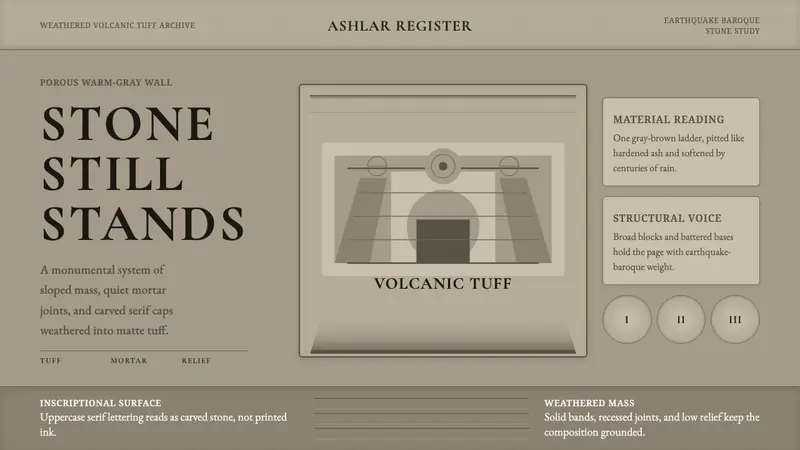 Philippine Adobe TuffStone refuses polish. Warm tuff gray, incised serif caps, and buttress-heavy bands.
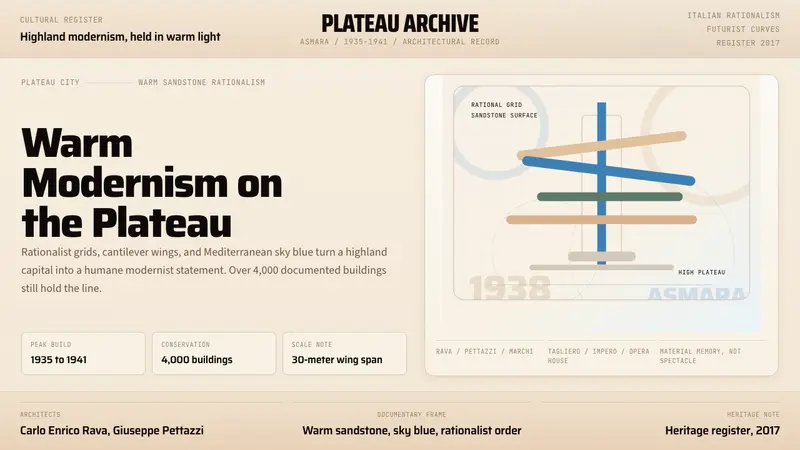 Eritrean Asmara Italian ModernismHuman modernism, not cold monumentality. Sandstone panels, sky-blue cantilevers.
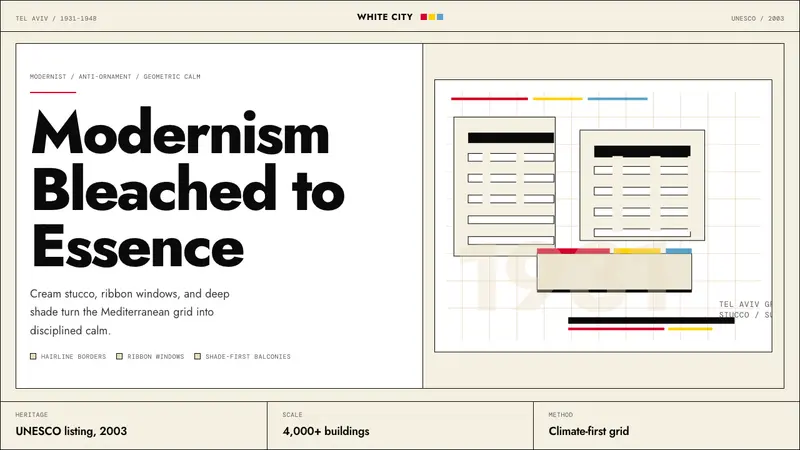 Israeli Bauhaus Tel Aviv (White City)Austere urban modernism. Stucco-white grid, Jost type, hairline borders, and primary accents.
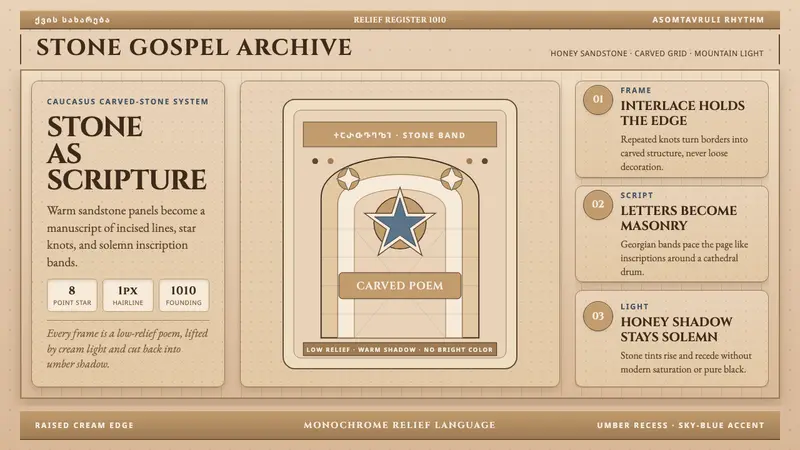 Georgian Nikortsminda Stone-CarvingStone becomes scripture. Cinzel caps and Georgian bands carve honey-sandstone grids.