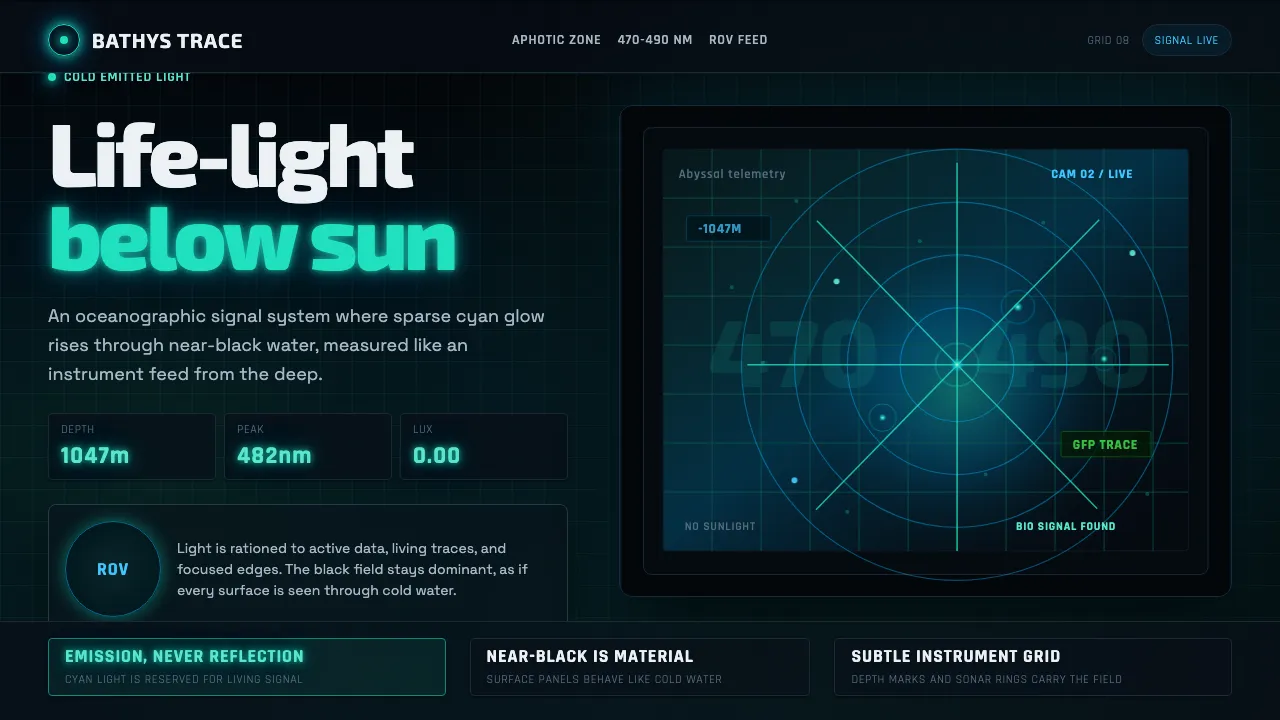
About Abyssal Bioluminescence
Below roughly 1000 metres the ocean enters the aphotic zone — water so deep that no sunlight survives and the only illumination is cold biological light. Marine bioluminescence peaks at 470–490 nm because blue-green travels farthest through seawater, so the abyss reads as electric cyan glow against a near-black field.
This system borrows the language of submersible instruments and ROV camera feeds: emitted light, never reflected; sparse pinpoints and soft halos rising from depth; sonar and depth-gauge readouts. Glow is precious and rationed, the dark is the dominant material, and every surface behaves like something seen through cold water.
- Origin
- Global / deep ocean, oceanographic research
- Era
- 2010–now (contemporary deep-sea exploration / ROV imaging)
- Key figures
- NOAA Ocean Exploration · Smithsonian Ocean · Aequorea victoria · Malacosteus
- Movements
- Deep-sea exploration imagery · Bioluminescence science visualization
Abyssal Bioluminescence design spec
Colors
Typography
The other 11 sections — buttons, cards, spacing, motion, techniques and more — open once you unlock. Download the DESIGN.md or send it to your AI in one click. Unlock once, yours forever.
Sign up nowStyles similar to Abyssal Bioluminescence
Also inspired by science & nature, with a close feel.
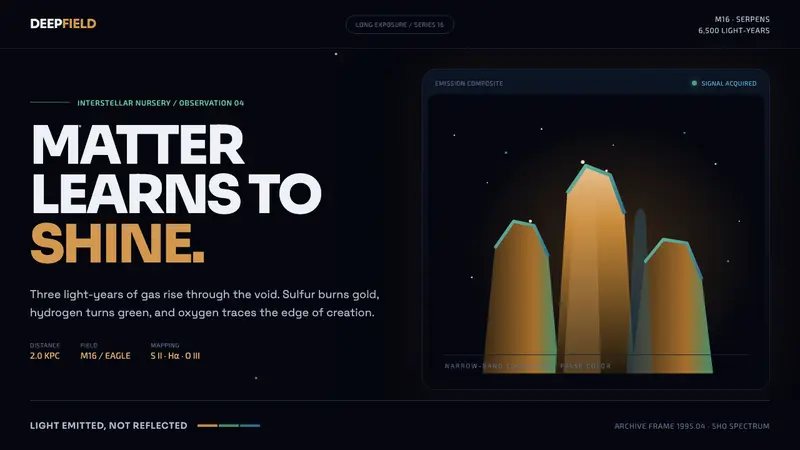 Hubble Pillars of CreationCreation glows from within. Amber towers rise through a cyan-green rim into the navy void.
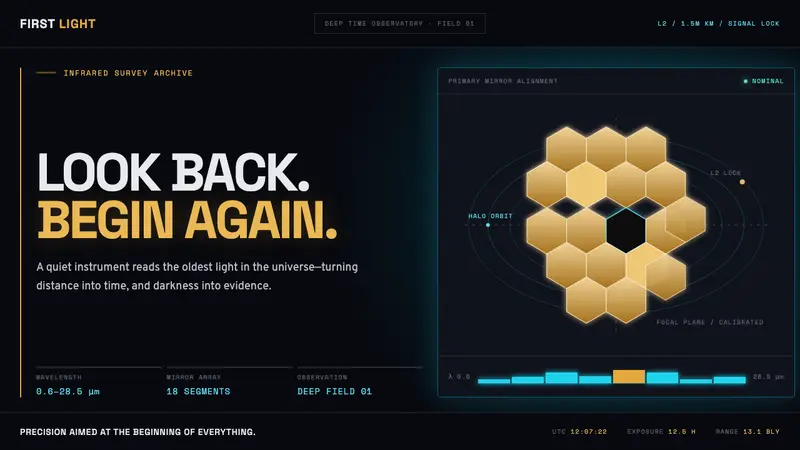 James Webb Telescope (2022)Precision meets deep time. Mirror gold hexagons and cyan telemetry glow across a black void.
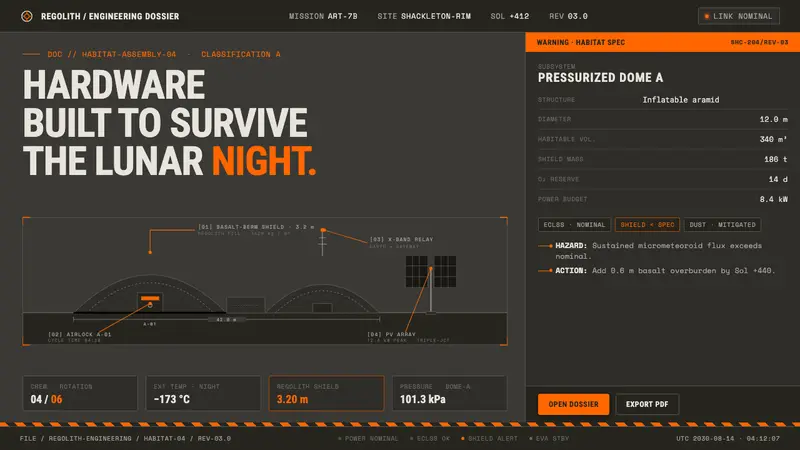 Lunar Base 2030Hardware built to survive the lunar night. Regolith gray, ANSI hazard orange, NASA mono callouts.
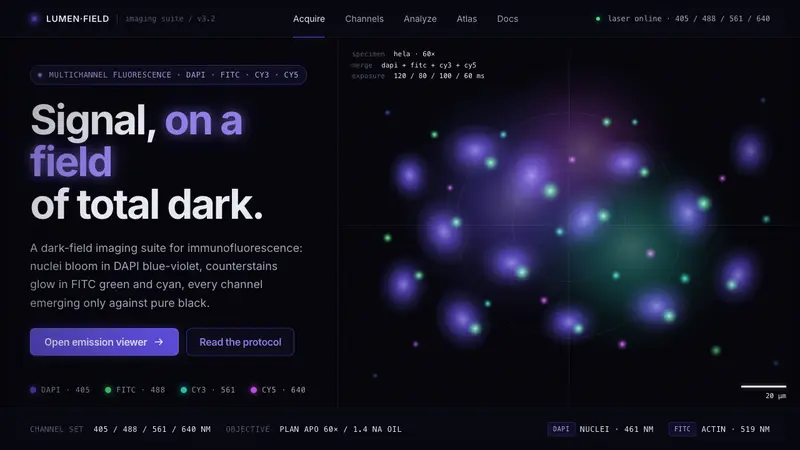 Cell MicroscopySignal on total dark. DAPI blue-violet and FITC green bloom as soft point-emission on pure black.