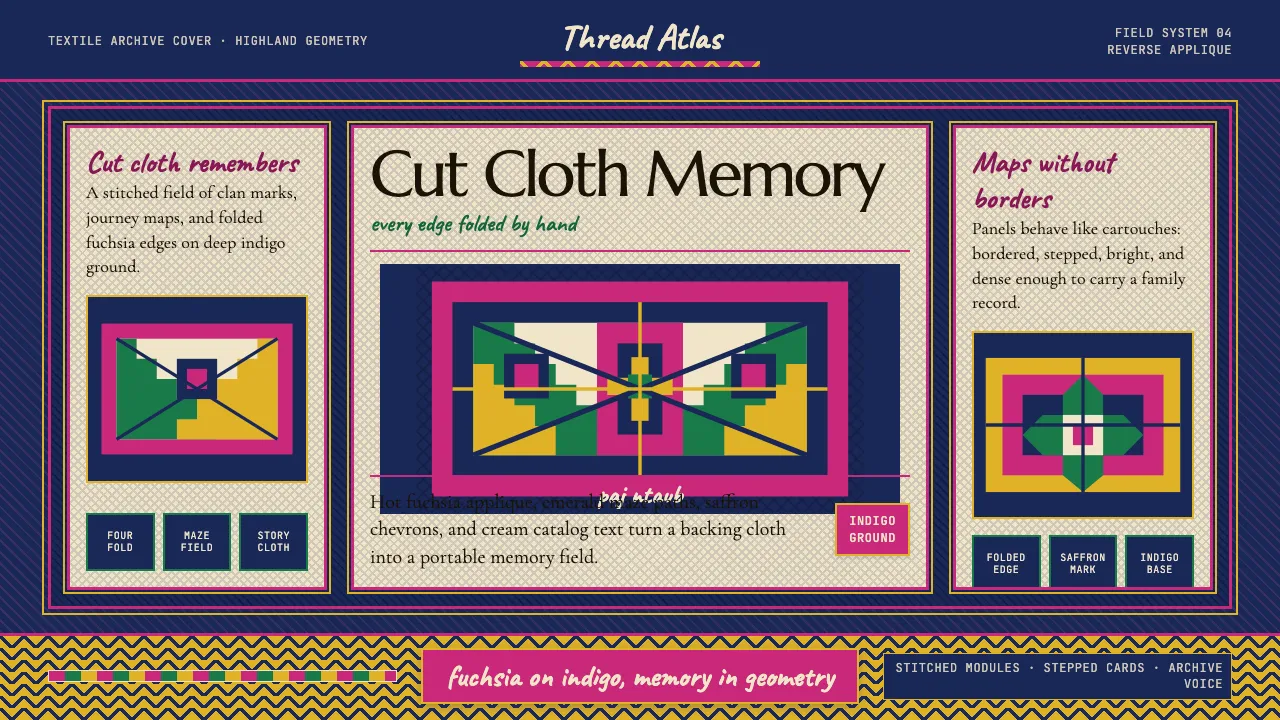
About Hmong Paj Ntaub (Flower Cloth)
Paj ntaub — "flower cloth" — is the Hmong women's art of cutting geometric mazes into a top fabric and stitching the folded edges onto a contrasting indigo backing. Spider webs, elephant-foot crosses, snail spirals, and mountain zigzags encode clan identity and cosmology in tight rotational symmetry. After 1975, refugee camps birthed the story-cloth subgenre: entire migration journeys embroidered as naive cartographic scenes.
This system channels that highland-loud palette — hot fuchsia applique on deep indigo ground, emerald and saffron accents, mountain-chevron borders — into a digital vocabulary of stepped-edge cards, cross-stitch textures, and cartouche buttons. Every surface carries the weight of hand-cut cloth.
- Origin
- Laos, Vietnam, Thailand highlands; diaspora USA (Minnesota, California), France
- Era
- pre-migration upland-China origins; Laos/Vietnam highland 19th c.; story-cloth genre 1976–1992 Ban Vinai camps
- Key figures
- Marsha MacDowell · Joanne Cubbs · Norma Diamond
- Movements
- Hmong reverse-applique (paj ntaub) tradition · Story-cloth diaspora genre · White Hmong / Green Hmong / Flower Hmong subgroups
Hmong Paj Ntaub (Flower Cloth) design spec
Colors
Typography
The other 11 sections — buttons, cards, spacing, motion, techniques and more — open once you unlock. Download the DESIGN.md or send it to your AI in one click. Unlock once, yours forever.
Sign up nowStyles similar to Hmong Paj Ntaub (Flower Cloth)
Also inspired by crafts & folk art, with a close feel.
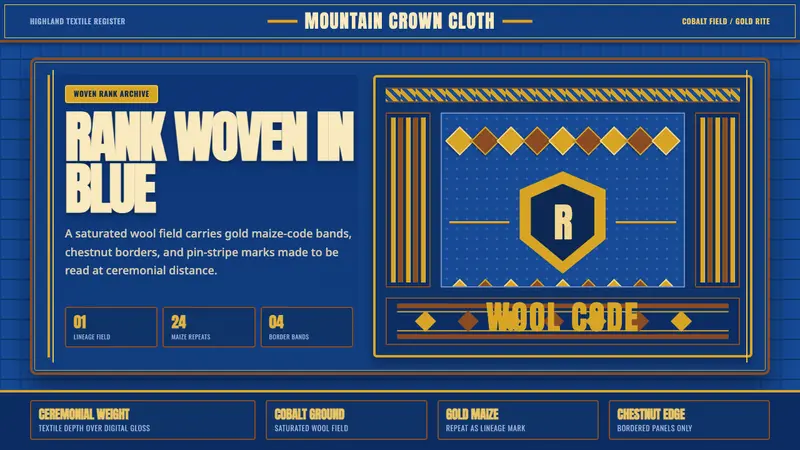 Basotho Seanamarena BlanketRank made visible. Cobalt wool, gold maize diamonds, and chestnut borders read like a crest.
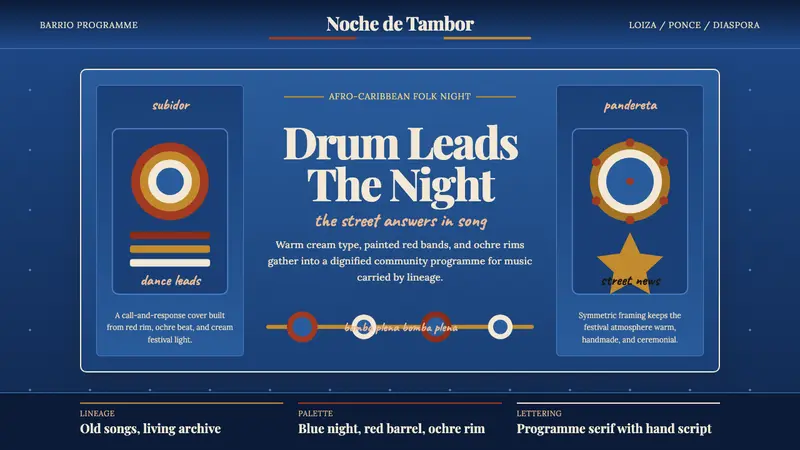 Puerto Rican Bomba & PlenaNight festival dignity. Drum-red stripes and cream Playfair type on deep tropical blue.
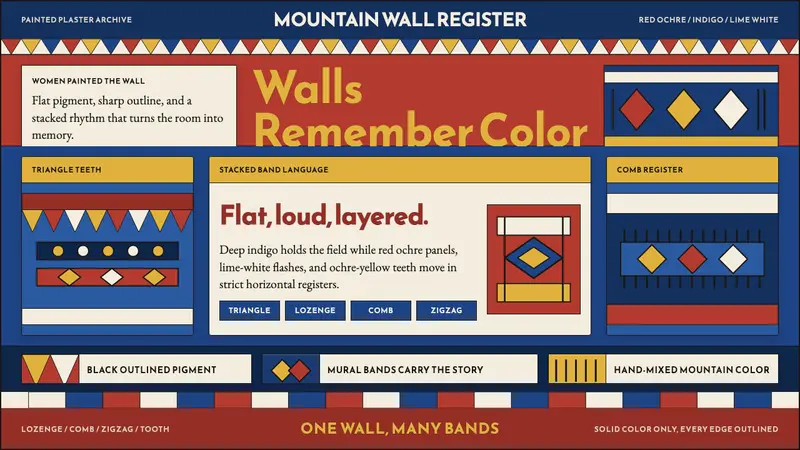 Saudi Asiri Qatt Wall PaintingPainted walls speak loudly. Indigo bands, red triangles, ochre teeth, black outlines.
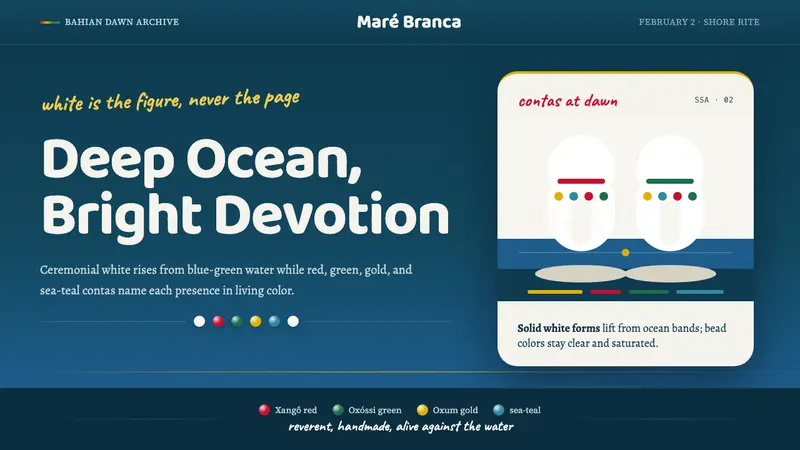 Candomblé OrixáReverent but alive. Ocean blue carries white figures and saturated bead-color strands.