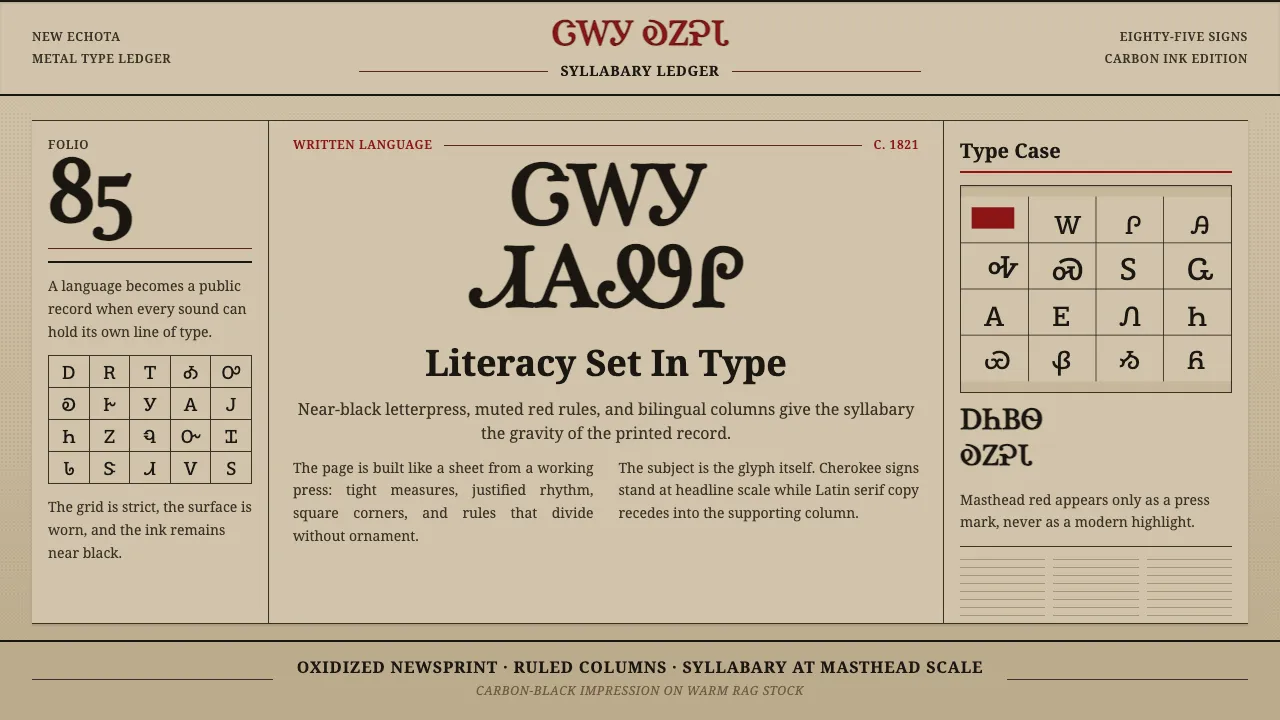
About Cherokee Syllabary
In 1821 Sequoyah completed an 85-character syllabary that let the Cherokee language be written for the first time, and within seven years it carried the Cherokee Phoenix — the first Native American newspaper — off a cast-metal press at New Echota. This system honors that medium: dense carbon-black ink bitten into aging rag newsprint, ruled columns, and the bilingual masthead that set Cherokee type beside Latin serif.
- Origin
- New Echota, Cherokee Nation, Georgia, North America
- Era
- Syllabary invented c.1821; Cherokee Phoenix first printed Feb 21 1828; visual bracket 1900–1950
- Key figures
- Sequoyah · Elias Boudinot · Samuel Worcester
- Movements
- Indigenous literacy and the press · Native American modernization of writing
Cherokee Syllabary design spec
Colors
Background
Surface
Primary
Secondary
Accent
Text
Typography
Plantagenet CherokeeHeadings
Noto SerifBody
Noto Sans CherokeeMono
Unlock for 1 credit
The other 11 sections — buttons, cards, spacing, motion, techniques and more — open once you unlock. Download the DESIGN.md or send it to your AI in one click. Unlock once, yours forever.
Sign up nowHave an account? Sign in
Styles similar to Cherokee Syllabary
Also inspired by print & type, with a close feel.
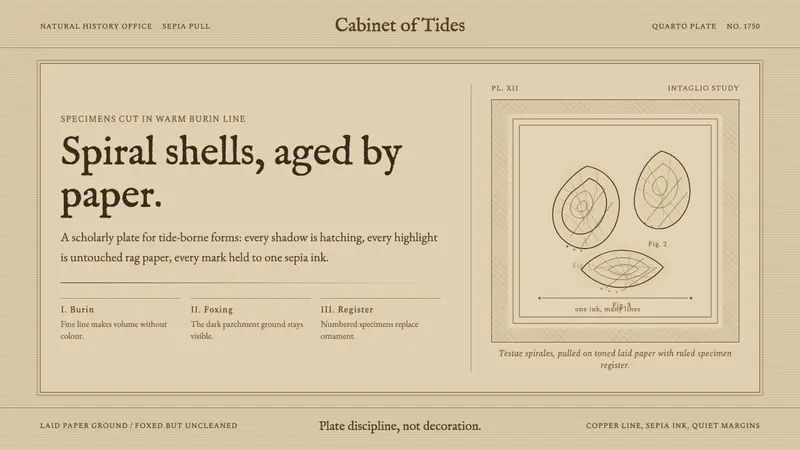 Conchology Shell PlateAged paper is the hero. Sepia Fell type and burin spirals make science feel antique.
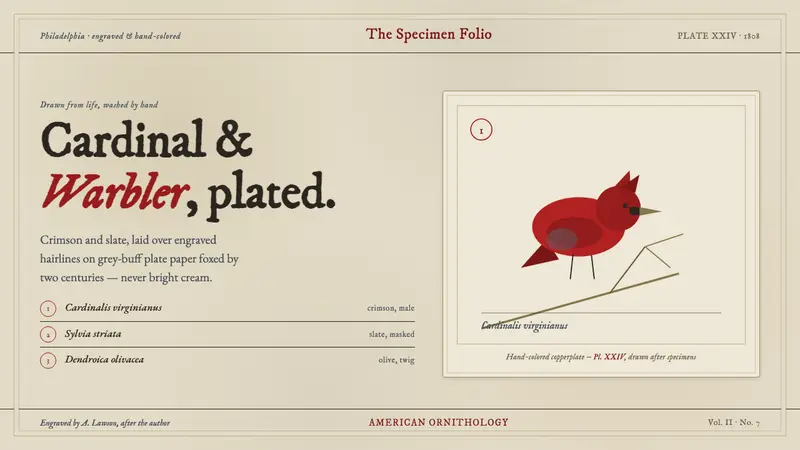 Wilson Ornithology PlateAn 1808 ornithology plate reborn. Cardinal crimson and slate, washed over engraving on foxed paper.
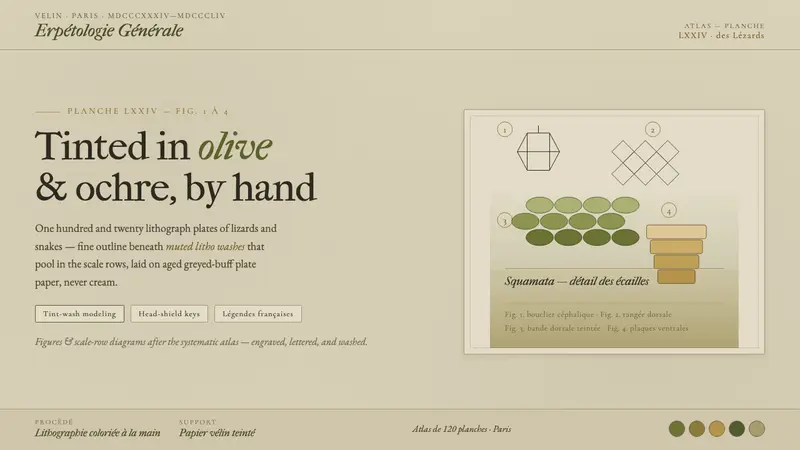 Herpetology Scale PlateA 19th-century herpetology atlas, digitized. Olive-and-ochre litho washes on buff plate paper.
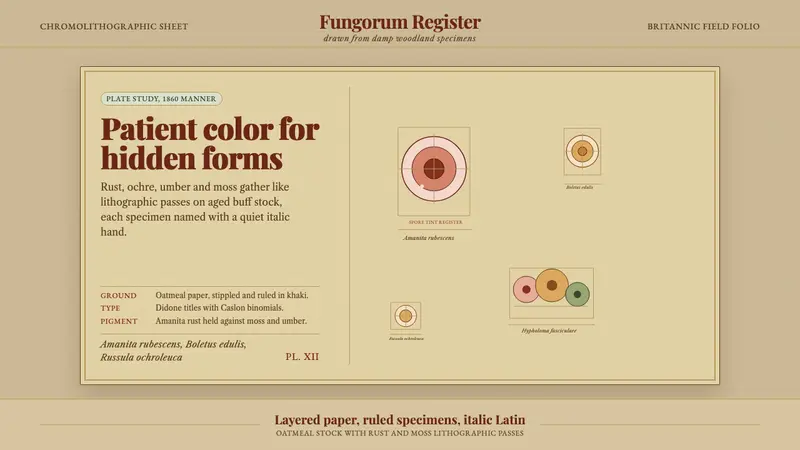 Victorian Mycology PlatePatient field science. Rust and moss specimens sit on stippled buff paper with italic Latin.